Introduction
Written artifacts are not simply old, timeworn papers. They are pieces of history that help researchers and lay people alike understand the lives and worlds of people past. Without these treasures, stories are lost and the past remains misunderstood.
However, physical archives often present boundaries for researchers. One must travel to the archive, request permission, analyze pieces for a limited time, and often decipher the archaic handwriting so unlike the twenty-first century prints. Creating meaning between text references, as Emily Sherwood, the Director of the Digital Scholarship Lab at the University of Rochester’s (UOR) River Campus Libraries in 2025 noted in a related video, “would take… an entire lifetime of research.”
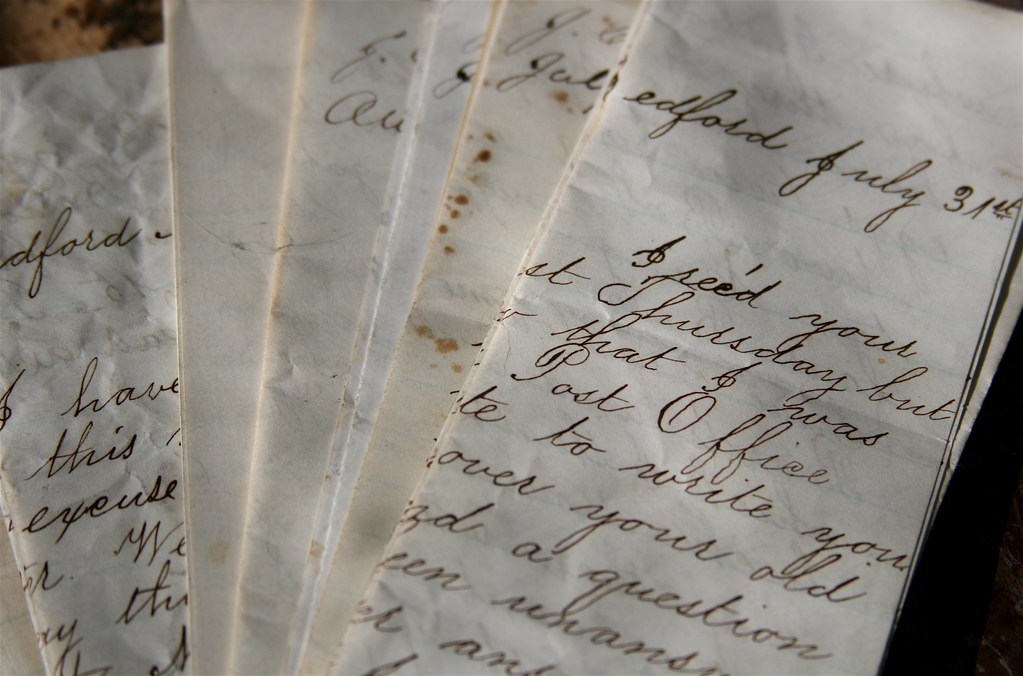
For this reason, according to the project’s “About” page, a talented team led by Thomas P. Slaughter created the Seward Family Digital Archive. The collection is based on the archives found at the UOR’s River Campus Libraries and other sources. Its goal? To transcribe the letters and other correspondence of William Henry Seward and his family’s extensive networks. Notably, the content, aesthetic qualities, and usability of this remarkable digital archive, despite several drawbacks, is a strong example of the present amplifying the past.
A Clear Mission
The Seward Family Digital Archive leaves no doubt of the purpose of its website: to make access to the Seward family’s history open to the public through their letters and other carefully selected written media. Outlining the transcription and digitization process in its “About” pages, the archive explains how photographs, transcriptions, edits, and Text Encoding Initiative (TEI) encoding create a comprehensive and simple-to navigate website.
Why is William Henry Seward and his family worth remembering? As the “The Sewards” page notes, Seward or Henry held an impressive career as a political figure that shaped American history with positions including “state senator (1831-1838), Governor of New York (1838-42), U.S. Senator (1849-60), and Secretary of State (1860-69) under Presidents Lincoln and Johnson” (“The Sewards”). The immense quantity of resources and connections within the archive shines light into a fascinating period of time.
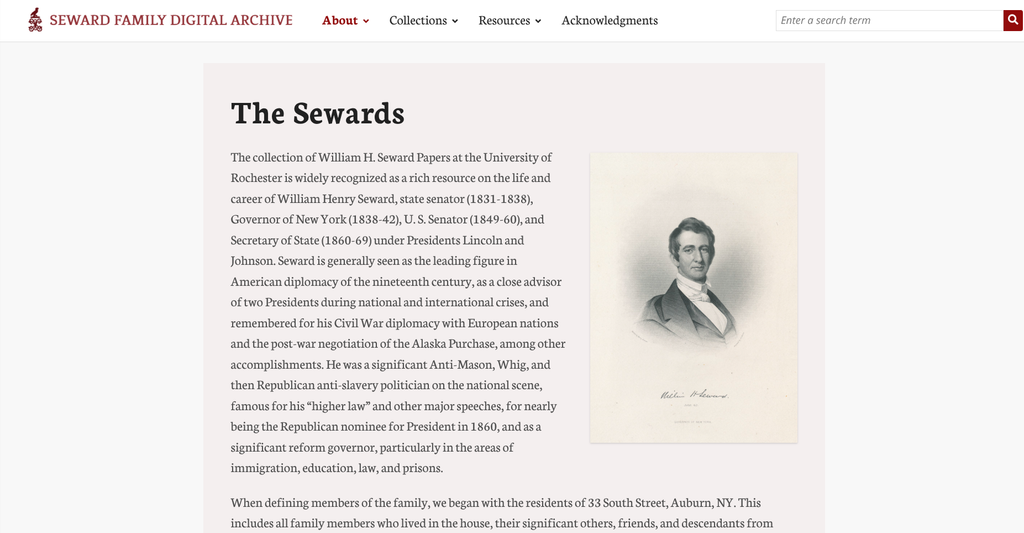
The notable connections created by Henry’s position and time spent away from his home in Auburn, New York, provide historians with thousands of manuscripts exploring nineteenth-century life. While the digital archive notes that its collections are still being documented, ongoing work into this project will allow visitors to access additional documents in the future.
User Experience and Media Usage
A well-researched collection of this magnitude is invaluable; however, a disorganized website can make the most thorough archive useless. Thankfully, this is not so with the Seward Family Digital Archive website. Its ability to make the user experience simple can be seen in the interconnected nature of the website.
For instance, if a researcher hoped to find correspondence between William Henry Seward and his wife Frances Adeline Miller Seward regarding the death of their young daughter Cornelia, there are several ways to recover the transcriptions they seek. Multiple search engines are available within the website, one covering the general collection and others, such as the People Database and Places Database , allowing for searches based on individuals and locations. No matter which technique one uses, the systems set in place make the work of researchers infinitely simpler.
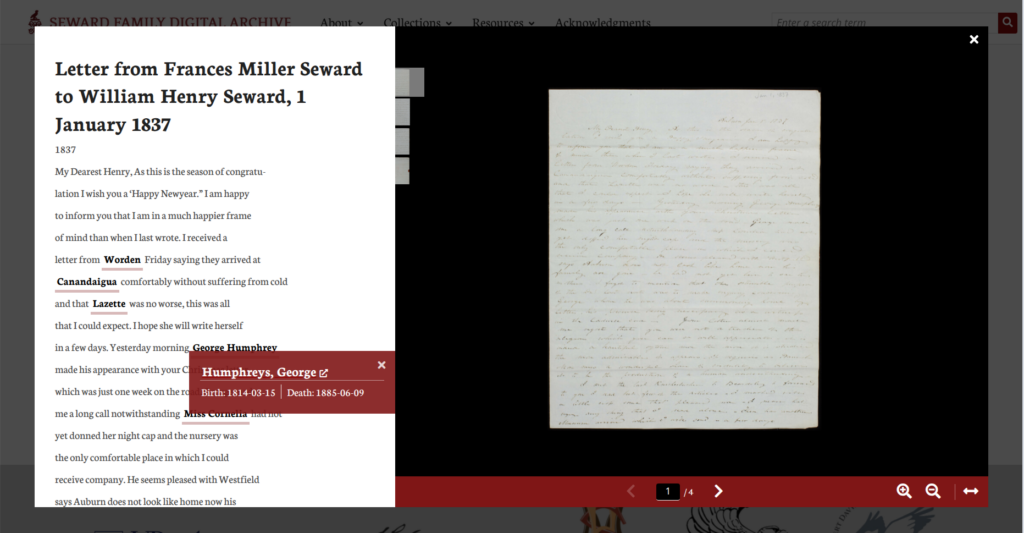
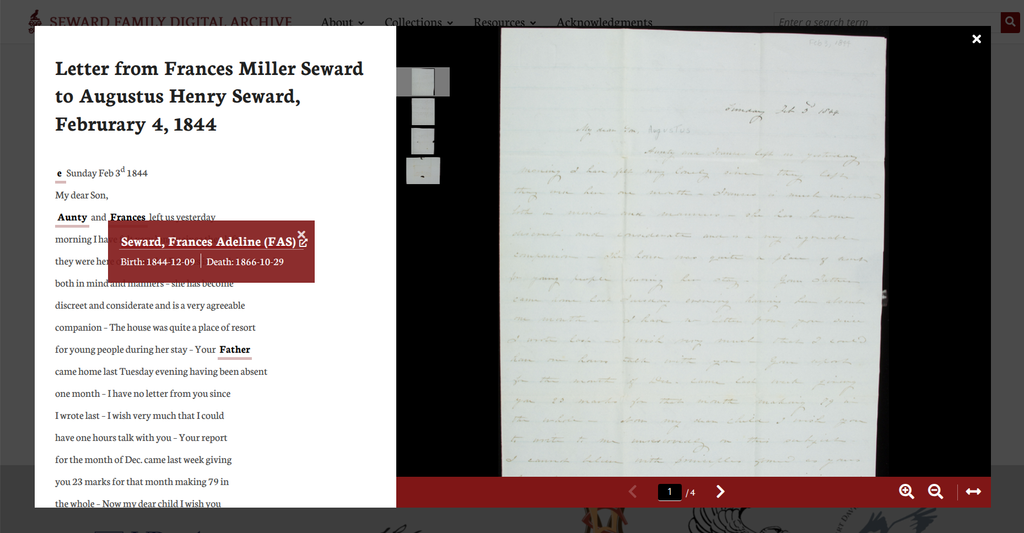
After discovering the letters they seek, a researcher can then take advantage of the side-by-side comparisons between the photographed original manuscript and the transcribed version to understand handwriting of the past. The Text Encoding Initiative (TEI) procedures conducted as one of the final steps before digital publication allows for readers to click on links about important people, places, and references for more information and, if available, more manuscripts. This allows researchers to discover the subject being referred to in as few clicks as possible, giving them more time to make new discoveries.
Accessibility
An overview of the website’s contents reveals a carefully planned and built collection. However, the true impact of a website is impacted by its overall accessibility to users. WebAIM’s WAVE Web Accessibility Evaluation Tool is a helpful platform that scans web pages for possible problems visitors using screen readers or other differences in ability might experience. The Seward Family Digital Archive homepage was able to earn an impressive score of 9.7 according to the Accessibility Impact (AIM) criteria dictated here.
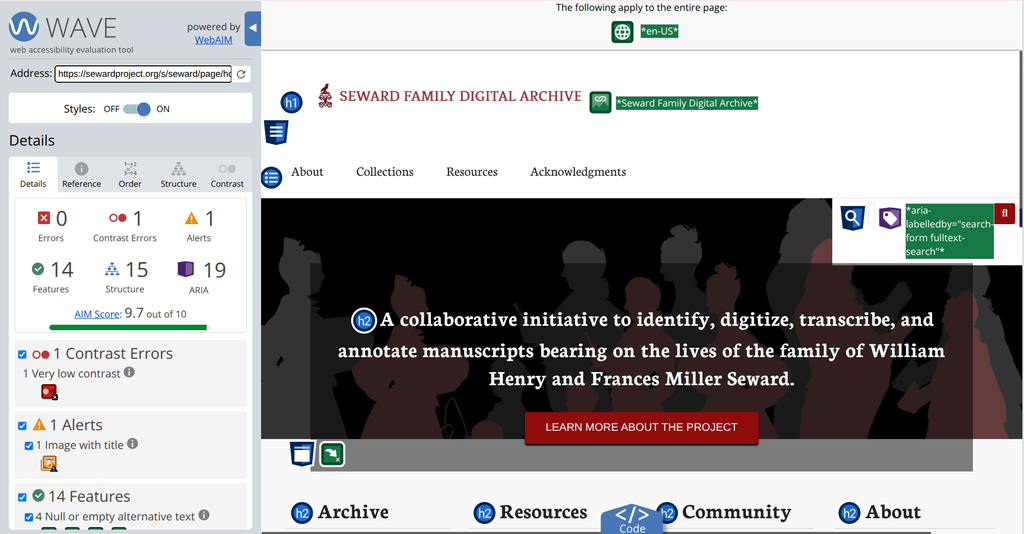
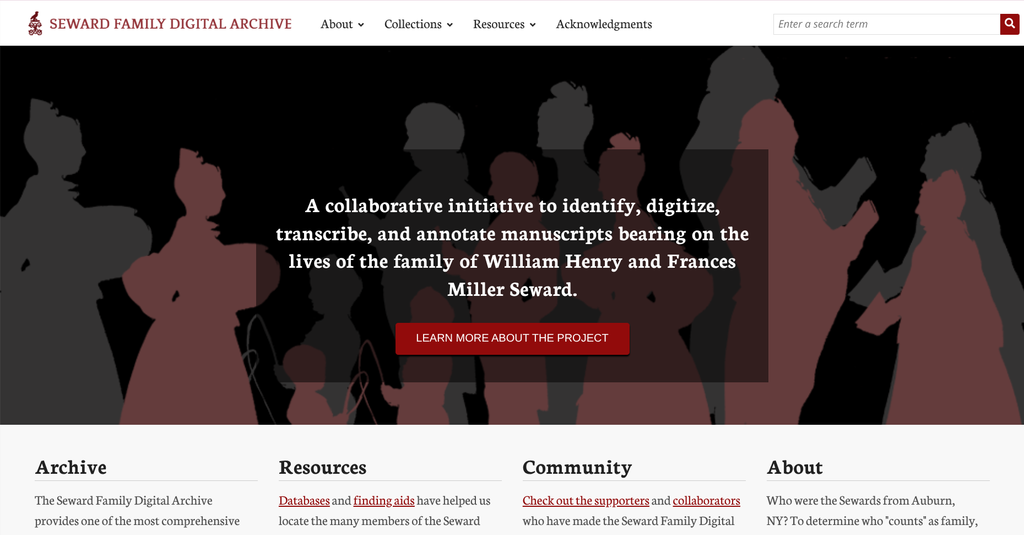
Two small recommendations are made by this test, the first being poor color contrast in the “Learn More about the Project” button within the header of the page. Choosing a darker shade of red would quickly resolve this problem for this page and other buttons following the same style. Additionally, the results suggest using alternative text for the title image instead of labeling it as a title attribute.
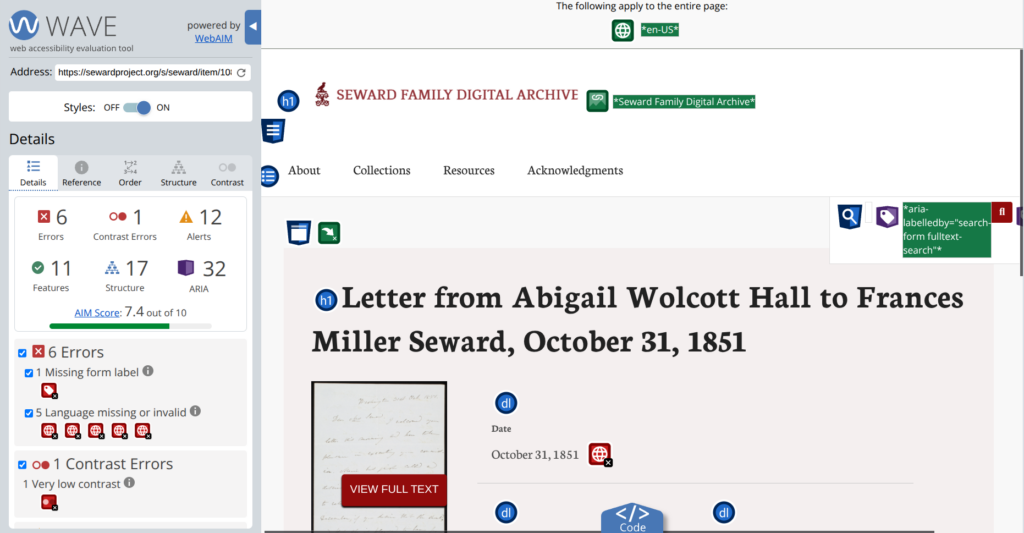
Unfortunately, the digital archive itself receives a lower score of 7.4, with reasons ranging from unidentified languages to an inability to access transcribed content with a keyboard. While usable to the majority of the population, the Seward Family Digital Archive has several problems that need to be addressed before it is fully accessible.
Aesthetics
The sleek simplicity of the website’s aesthetics catches users’ attention immediately. Unlike the often outdated and bare-boned format of online archives, the Steward Family Digital Archive creates simple yet comfortable pages that do not distract from but amplify their content. A consistent color palette of white, black, pinkish beige, and muted reds, likely inspired by the colors of Frances Adeline Seward’s journal accessible on the page, creates an atmosphere of both times long past and rejuvenation.
Along with its overall design choices, the Seward Family Digital Archives uses a multi-modal approach to presenting information. Photos of staff, historical figures, and manuscripts, videos and documents discussing the various methods and stories behind the work, and the detailed silhouetted drawing of members of the Seward clan that decorates Seward-related content give visitors an incentive to learn more about the project.
Improving the Digital Archive
Despite taking a more modern and accessible approach in the design of the archive, the Seward Family Digital Archive has several points that can be improved.
- First, the copyright of the website has not been updated on the page since 2022, a small detail that might harm the perceived reliability of the website. While an archive of this type does not require frequent updates, this point can shape the trustworthiness of the archive and shows careful attention on the part of the designers.

- Secondly, the inclusion of more student work or analyses of the materials themselves will help users explore historical context through the eyes of the people of today and strengthen the link between then and now.
- Third, a thorough overview of the accuracy of the TEI links might be needed. For instance, under the profile of Frances “Fanny” Adeline Seward are several mentions that more likely refer to Fanny’s cousin Frances Worden Chesebro due to the fact that Fanny was not alive during their creation. While this is perhaps one of few examples of charting mistakes, it might be worth taking the time to reevaluate whether certain TEI references are connected to the correct people.
- Finally, addressing the accessibility issues uncovered by the WebAIM test will improve the user experience for all visitors. What appears to be small inconveniences to the average reader could be a serious obstacle to others, and ensuring that the web archive’s contents are usable by everyone helps the project’s mission reach complete fruition.
Conclusion
The impressive execution and design of the Seward Family Digital Archive demonstrates a perfect balance between the past and the present, usability and details. Archives such as this one bring the past into the future in a format that is accessible to many and that sheds light on some of the most important points in U.S. history. This archive does have a handful of issues that must be resolved to reach its fullest abilities. However, the foundations of the archive are strong. Through a new examination of content links and accessibility, the Seward Family Digital Archive will remain a treasured resource for generations to come.
Works Cited
“About.” Emily Sherwood, esherwood.org/about/. Accessed 19 Oct. 2026.
“Digital Humanities and the Seward Family Digital Archive.” YouTube, uploaded by the University of Rochester,
23 Feb. 2021, www.youtube.com/watch?v=YNs2jhuPspw&t=20s.
Hall, Abigail Wolcott. Letter to Frances Miller Seward. 31 Oct. 1851. The Seward collections. The Seward Family Digital Archives. sewardproject.org/s/seward/item/108807. Accessed on 19 Oct. 2026.
“Home.” Seward Family Digital Archive, University of Rochester, sewardproject.org/s/seward/page/home. Accessed 19 Oct. 2026.
“People Database.” Seward Family Digital Archive, University of Rochester, sewardproject.org/s/seward/faceted-browse/1. Accessed 19 Oct. 2026.
“Places Database.” Seward Family Digital Archive, University of Rochester, sewardproject.org/s/seward/faceted-browse/3. Accessed 19 Oct. 2026.
“The Project.” Seward Family Digital Archive, University of Rochester, sewardproject.org/s/seward/page/project. Accessed 19 Oct. 2026.
Seward, Frances Miller. Letter to Augustus Henry Seward. 4 Feb. 1844. The Seward collections. The Seward Family Digital Archives. sewardproject.org/s/seward/item/105331. Accessed on 19 Oct. 2026.
Seward, Frances Miller. Letter to William Henry Seward. 1 Jan. 1837. The Seward collections. The Seward Family Digital Archives. sewardproject.org/s/seward/item/100801. Accessed on 19 Oct. 2026.
“The Sewards.” Seward Family Digital Archive, University of Rochester, sewardproject.org/s/seward/page/sewards. Accessed 19 Oct. 2026.
“WAVE Aim Score.” WAVE Web Accessibility Evaluation Tool, Utah State University, wave.webaim.org/aimscore. Accessed on 19 Oct. 2026.
“WAVE | Web Accessibility Evaluation Tool Report of https://sewardproject.org/s/seward/item/108807.” WAVE Web Accessibility Evaluation Tool, Utah State University, wave.webaim.org/report#/https://sewardproject.org/s/seward/item/108807. Accessed on 19 Oct. 2026.
“WAVE | Web Accessibility Evaluation Tool Report of https://sewardproject.org/s/seward/page/home.” WAVE Web Accessibility Evaluation Tool, Utah State University, wave.webaim.org/report#/https://sewardproject.org/s/seward/page/home. Accessed on 19 Oct. 2026.